UK Specialty Training Competition Ratios (2025): What the Latest 2026 Recruitment Data Means

Competition ratios are one of the first things doctors look at when deciding which specialty to apply for. In this guide, we explain what competition ratios really tell you, set out the latest available UK specialty training competition ratios, explain how the Medical Training (Prioritisation) Act 2026 has changed recruitment, and look ahead to the further changes taking effect for 2027 recruitment.

The key change for 2027 is that prioritisation will apply at both the shortlisting and offer stages. This means that historic headline competition ratios need to be interpreted more carefully than ever.

Author: Olivier Picard | Last updated: September 2026 | Data source: NHS England / Oriel | Coverage: CT1/ST1 and ST3/ST4 competition ratios


UK doctor pondering over the meaning of competition ratios for CT and ST applications.

Competition ratios - Key takeaways

  • Competition ratios don't tell the whole story.
    The latest complete specialty-level competition ratios are from 2025 and therefore pre-date the Medical Training (Prioritisation) Act 2026. In 2026, prioritisation was applied at the offer stage. From 2027 recruitment, prioritisation will also apply at shortlisting. As a result, the headline number of applications per post is becoming an increasingly imperfect measure of the competition actually faced by an individual applicant.
  • Your ranking matters more than the headline ratio.
    Candidates are ranked using a combination of their portfolio, a degree of self-assessment and their interview performance. It means that making even just small improvements can dramatically increase your chances of receiving an offer.
  • Preparation consistently beats competition.
    The strongest applicants (and therefore those who are successful) focus on maximising portfolio points and practising for interviews rather than worrying about the published competition ratios. At the end of the day, all the data points to the fact that systematic preparation remains the single biggest predictor of success. You need to worry about what you can control and less about things you can't do anything about.

What do competition ratios really mean?

Understandably, the annual publication of UK specialty training competition ratios cause a lot of anxiety among junior doctors. Each year, thousands of applicants scan the latest recruitment figures, hoping that their favourite specialty has become a little less competitive. So it's always a shock to see competition ratios of 6:1, 10:1 or even higher. When you see this type of ration, you're left wondering whether, realistically,  you have any chance of obtaining a training post.

On the surface, a competition ratio of 10:1 gives you the feeling that only 10% of applicants will be get a training post in that specialty. Luckily, the reality is bit more encouraging. What people tend to ignore (or forget) is that one thing that competition ratios don't measure is the quality of applicants. They also ignore the fact that doctors can be applying to several specialties at the same time. And they certainly don't predict the chances of success for an individual doctor who has prepared thoroughly.

In this guide, I have brought together the latest complete specialty-by-specialty competition ratio data published by NHS England (2025), I also explains why competition has increased in recent years, I explore how the Medical Training (Prioritisation) Act 2026 has changed the recruitment landscape, and I examine the major bottlenecks at both CT1/ST1 and ST3/ST4 entry.

Most importantly, I set out why your preparation matters far more than the headline competition ratio. Whether you are applying for Internal Medicine Training, Core Surgical Training, Anaesthetics, Radiology, General Practice, Psychiatry or any other specialty, understanding what these figures actually represent will help you interpret them correctly, and hopefully reduce some unnecessary anxiety.

What do competition ratios actually measure?

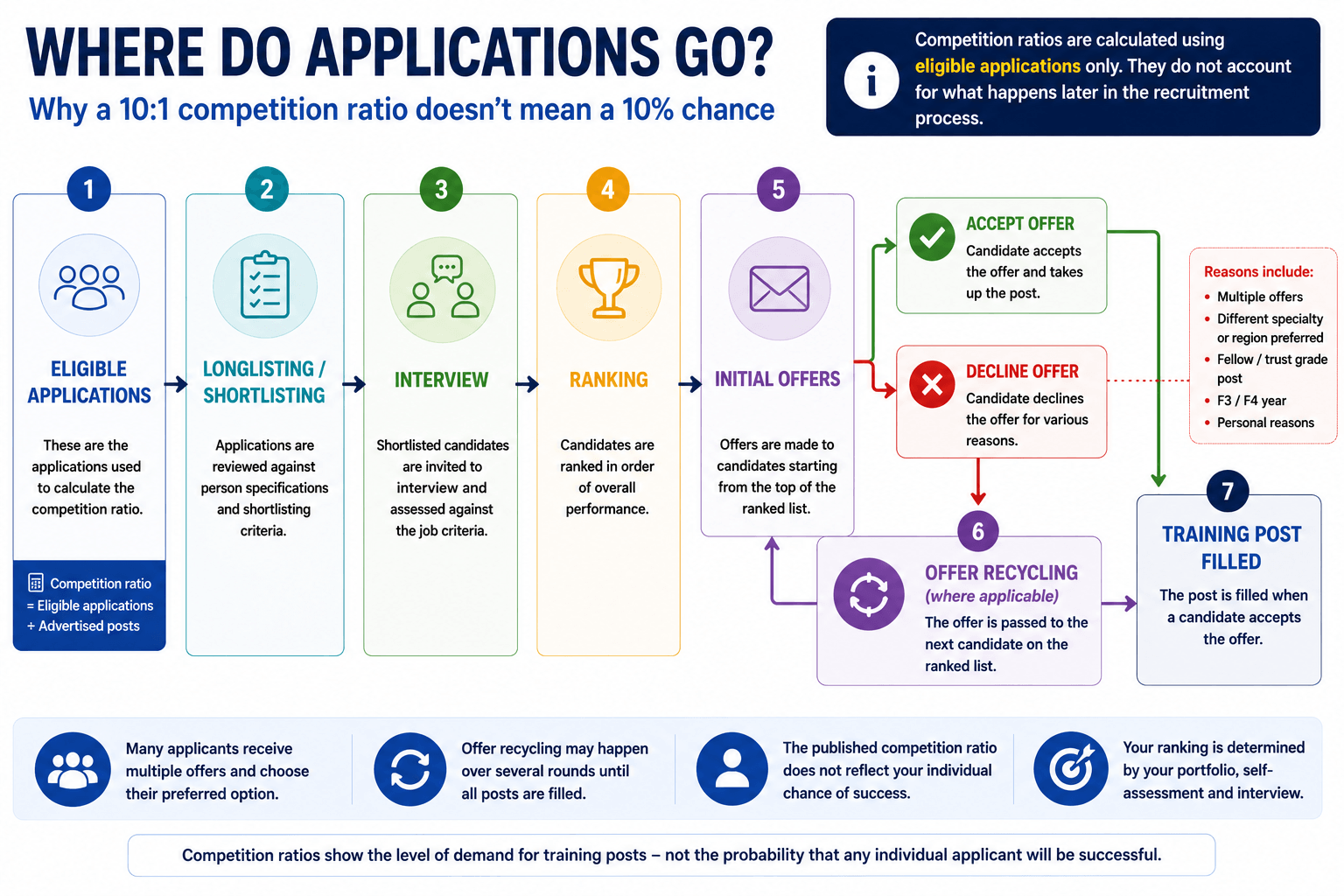
Contrary to popular belief, competition ratios don't represent your chance of getting a training post.  A competition ratio is simply a measure of demand for available training places. The calculation is simple:  Competition Ratio = Number of Eligible Applications ÷ Number of Available Posts. So, for example, if 2,000 eligible applications are received for 500 training posts, the competition ratio is: 2,000 ÷ 500 = 4.0. This would be reported as a competition ratio of 4:1. And while the calculation is simple, interpreting the figure requires a little more thought. Here is why:


Applications are not the same as applicants

The most important point you need to understand is that recruitment statistics count the number of applications, and not the number of individual doctors. And  this distinction is far more important than many applicants realise. The figures published by NHS England show that, during the 2025 Round 1 recruitment cycle, applicants submitted on average 2.37 specialty applications each. Basically, many doctors applied to several specialties simultaneously, which means that the published competition ratios account for the same applicant multiple times. For example, if one doctor applies simultaneously for Internal Medicine Training (IMT), General Practice (GP) and Psychiatry, the recruitment statistics will record three separate applications.

There are also other factors that come into play. Many applicants withdraw before interview, decline interview invitations, receive multiple offers and ultimately accept a different specialty. As a result, the published medical specialty competition ratios inevitably overestimate the number of doctors genuinely competing for each post.


Competition ratios measure demand, they don't measure difficulty

It is probably best to regard competition ratios as a measure of popularity rather than as a measure of chances of success. They give you an idea of the number of eligible applications that were submitted for each available training post, but they don't tell you how strong the average applicant is, how many applicants are realistically appointable (some candidates will literally have scraped through the shortlisting and a poor interview performance will simply kill their chances of getting a post), how many candidates applied as a back-up option, or how many applicants will eventually accept a post in another specialty.

If you are applying to a specialty with a competition ratio of 8:1, it doesn't mean you have only a 12.5% chance of success. The strongest applicants frequently receive offers in several specialties, while weaker applications may never reach appointable standard. So if you are a strong candidate, your chance of getting that post may be close to, say, 90%. Whereas, if you are borderline, you may only have a 2% chance. Recruitment is not a lottery, it's a ranking exercise!


Competition ratios vary enormously between specialties

Behind the headline national competition ratios, there is considerable hidden geographical variation. The level of competition can vary significantly between deaneries. Historically, London, the North West and the West Midlands have attracted some of the highest competition ratios because they have a high concentration of teaching or university hospitals, tertiary referral centres and academic opportunities. On the other hand, regions that are less densely populated often attract fewer applicants even though they are offering the same nationally recognised training programme. Therefore, if you are an applicant who is geographically flexible, you might improve your chances of obtaining a training post without changing specialty simply by applying to a broader range of deaneries.


Competition also varies by region

Not all specialties experience the same level of competition. Some specialties recruit relatively large numbers of trainees each year, whilst other specialties have only a handful of available posts nationally. Obviously, you tend to find higher competition ratios in highly specialised programmes because a relatively small increase in application numbers can dramatically impact on the overall ratio.

Workforce planning also plays an important role. The NHS will often open additional training posts in specialties where an expansion of consultant posts is required to cater for increasing demand, thereby reducing competition. This has been the case in psychiatry, radiology, oncology and some areas of emergency and acute medicine.  In contrast, specialties with limited expansion opportunities often remain highly competitive year after year. That's why it is important to compare specialty competition ratios within the context of workforce planning rather than viewing the figures in isolation.

Diagram showing how UK specialty competion ratios for CT and ST posts do not provide the full picture.


The 2026 Medical Training Prioritisation Act: A fundamental change to specialty recruitment

The introduction of the Medical Training (Prioritisation) Act 2026 brought one of the most significant changes to UK specialty recruitment in recent years.

For many years, all eligible applicants competed against one another for specialty training posts. As the number of applicants increased (that increase being mostly driven by expanding UK medical school places, growth in the GMC register and increasing numbers of International Medical Graduates (IMGs)), competition ratios increased across almost every specialty. Unfortunately, the number of available training posts failed to increase at the same pace, which left many UK-trained doctors unable to secure a training post after completing Foundation Training.

The Medical Training (Prioritisation) Act was introduced to address this imbalance by giving priority to UK medical graduates and other defined priority groups during specialty recruitment. The first recruitment round under the new legislation has shown this has had a significant impact on recruitment.


How did prioritisation work in 2026?

For the 2026 recruitment round, prioritisation was applied at the offer stage.

Applicants continued through the normal specialty selection process and were assessed and ranked according to the relevant recruitment criteria. Depending on the specialty, this could include the Multi-Specialty Recruitment Assessment (MSRA), portfolio or self-assessment scoring and interview.

Prioritisation did not change the rank applicants received following the selection process.

The important change occurred when training posts were allocated.

Appointable priority applicants were considered for offers in rank order before appointable non-priority applicants. Non-priority applicants could therefore receive an offer only once the list of appointable priority applicants had been exhausted and vacancies remained.

Being a priority applicant did not guarantee an offer. Applicants still had to meet the required eligibility and appointability standards and achieve a sufficiently high ranking within the recruitment process.

The effect of prioritisation was therefore not to replace competitive selection, but to change the order in which appointable candidates were considered for available posts.

Official guidance: NHS England – Prioritisation for Specialty Recruitment


Other recruitment changes introduced in 2026

Prioritisation was not the only important change introduced for the 2026 specialty recruitment round.

A maximum of five applications was introduced for Round 1 CT1/ST1 recruitment. This limited the number of different specialties to which an individual applicant could apply during the round.

This is particularly relevant when interpreting future competition ratios because recruitment statistics count applications rather than individual doctors. Historically, applicants could submit applications to multiple specialties simultaneously, meaning the same doctor could appear in the application figures for several different programmes.

Limiting Round 1 applicants to five applications should reduce some of this multiple-application effect, although it does not remove it completely.

There was also a change to GMC registration requirements. Applicants who required full GMC registration were required to hold it at the point specified by the 2026 recruitment rules rather than relying on obtaining the necessary registration later in the recruitment process.

These changes, together with prioritisation and the expansion of specialty training places, mean that competition figures produced under the new recruitment system should not be compared directly with historic ratios without considering how the underlying recruitment rules have changed.


2026 Recruitment at a glance

The first recruitment round following the introduction of prioritisation provides an important indication of how significantly the new system can affect the interpretation of competition ratios.

According to NHS England’s corrected management information:

  • 33,953 appointable applications were recorded;
  • There were 9,315 specialty training posts;
  • 16,066 applications were from prioritised candidates;
  • This represented approximately 4 appointable applications per post overall;
  • Among prioritised applicants, the corresponding figure was approximately 2 applications per post;
  • 98% of posts were filled by priority candidates, compared with 72% in 2025;
  • In Round 1, only 163 accepted offers were from non-prioritised applicants;
  • This represented 1.80% of accepted Round 1 offers, compared with 27.95% in the previous year; and
  • 100% of General Practice training places were accepted by UK graduates or applicants working in the NHS.

These are national recruitment figures rather than specialty-specific competition ratios.

Nevertheless, they demonstrate why traditional competition ratios now require more careful interpretation. A headline figure of approximately four appointable applications per post does not mean that every applicant was competing for those posts on the same basis.

For priority applicants, the effective level of competition was substantially different from the overall headline figure.

For non-priority applicants, the 2026 results also demonstrate that reaching appointable standard did not necessarily result in an offer once priority applicants had been considered.

NHS England has not yet published complete specialty-by-specialty competition ratios for the 2026 recruitment round. The detailed specialty tables later in this guide therefore continue to show the latest complete specialty-level dataset, which is from 2025.

Source: NHS England – Impact of Medical Training Prioritisation Act on Specialty Training Recruitment


What changes for 2027 specialty recruitment?

The prioritisation system develops further for the 2027 recruitment cycle.

For 2026 recruitment, prioritisation was introduced during an active recruitment cycle and was applied when training offers were allocated.

For 2027 recruitment, prioritisation also applies earlier in the recruitment process, including at shortlisting where shortlisting is used.

Priority status therefore needs to be considered at two stages of recruitment:

  1. Shortlisting, where applicable; and
  2. Allocation of training offers.

Prioritisation does not replace the normal specialty selection process. Applicants must still meet the relevant eligibility requirements and achieve the required standard in the assessments used by their specialty.

Following interview, applicants continue to be ranked according to their performance in the selection process. Prioritisation does not change the rank awarded to an applicant.

When offers are allocated, appointable applicants in the priority group are considered in rank order before appointable applicants outside the priority group.

This distinction is increasingly important when interpreting competition ratios. Two doctors can appear within the same headline application figures but experience different effective levels of competition depending on their prioritisation status.

Official guidance: NHS England – Prioritisation for Specialty Recruitment


Who will be prioritised in 2027?

The Medical Training (Prioritisation) Act provides priority to specified groups, including UK medical graduates and applicants who have completed, or are currently undertaking, relevant qualifying UK training programmes.

For 2026 recruitment, certain immigration statuses were also used as a practical proxy for significant NHS experience.

However, these immigration-status criteria do not automatically apply to 2027 recruitment.

For 2027, the legislation allows the Government to define an additional priority group through regulations, including by reference to significant NHS experience or immigration status.

At the time of our September 2026 update, the final regulations defining this additional 2027 priority group have not yet been confirmed.

NHS England has said that the four UK nations are working towards a consistent approach and expects updated information to be available ahead of the 2027 application round.

Doctors applying for 2027 specialty training should therefore be aware that the final definition of the additional priority group is still awaited.

Latest official update: NHS England – Important Update for Applicants Interested in 2027 Medical Specialty Recruitment

Legislation: Medical Training (Prioritisation) Act 2026

Why are competition ratios rising?

One question many doctors ask is whether specialty training has genuinely become more competitive, or whether it simply feels that way. The answer is that competition has increased significantly over the past decade, but not because doctors have suddenly become more capable or ambitious. Instead, a combination of workforce planning, demographic changes and recruitment policy has resulted in far more applications chasing a relatively modest increase in training places. Understanding why this has happened helps explain why competition ratios should be interpreted with caution.


The NHS needs more doctors, but not enough training posts have been created

Over the last decade, the NHS has expanded both undergraduate medical education and international recruitment to address growing workforce shortages. Medical school places have increased substantially, while the General Medical Council (GMC) register now contains more doctors than ever before. At the same time, many International Medical Graduates (IMGs) have become eligible to apply for UK specialty training.

Increasing medical school places is relatively straightforward, but expanding specialty training is not. Every additional training post requires long-term funding, educational supervisors, clinical supervisors, appropriate clinical placements, protected teaching time and GMC-approved training capacity. As a result, training numbers inevitably increase much more slowly than the number of eligible applicants. These requirements mean expansion occurs gradually, creating inevitable pressure at specialty recruitment.


The reapplication effect

Competition ratios also tend to overestimate how many doctors are genuinely competing for a post because they count applications rather than people. Imagine two applicants.

  • Applicant A applies only for Radiology.
  • Applicant B applies for Radiology, Internal Medicine Training, General Practice and Psychiatry.

The recruitment statistics record five applications, despite there being only two applicants.

The same phenomenon occurs with unsuccessful applicants. Doctors who narrowly miss out frequently reapply the following year, often with stronger portfolios and more interview experience. This creates what might be called the reapplication effect - the annual applicant pool includes many experienced candidates returning for another attempt rather than entirely new graduates.

Fortunately, this is often good news rather than bad. Most repeat applicants substantially improve their application between recruitment rounds, demonstrating that success depends far more on preparation than luck.


Competition varies between specialties

Not all specialties experience the same level of competition. Several factors influence demand:

  • Lifestyle: Specialties offering greater flexibility, predictable working patterns or opportunities for private practice often attract larger numbers of applicants.
  • Workforce Planning: Some specialties deliberately expand recruitment because of consultant shortages. General Practice and Psychiatry have both seen substantial national investment in expanding training numbers. However, applicant numbers have also risen considerably, meaning competition remains strong despite workforce expansion. By contrast, specialties with relatively small consultant workforces cannot increase training numbers rapidly without risking unemployment after completion of training.
  • Prestige and Career Aspirations: Highly specialised fields such as Neurosurgery, Plastic Surgery, Ophthalmology and Radiology have traditionally attracted large numbers of applicants relative to available posts. These specialties often require significant portfolio development long before applications open.
  • Perceived Competitiveness: Interestingly, perception itself can influence competition. Some doctors avoid applying to highly competitive specialties because they assume they have little chance of success. Others deliberately choose a specialty they perceive to be "easier." Ironically, this means competition ratios fluctuate from year to year as applicants respond to previous recruitment data.

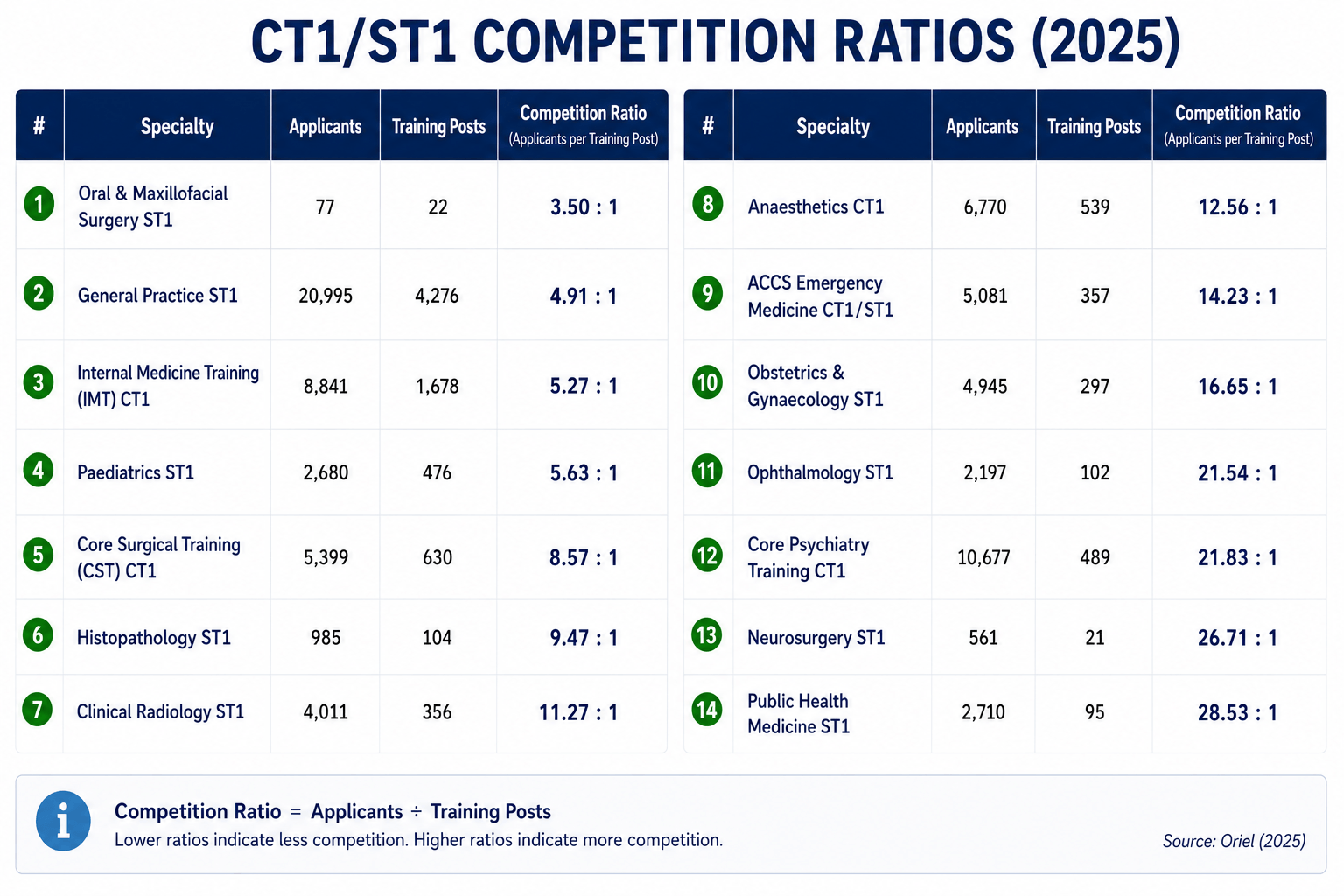
2025 Competition ratios for CT1/ST1 entry

The table below shows the latest complete official NHS England specialty-level competition ratios for CT1/ST1 recruitment.

These figures relate to 2025 and therefore pre-date the introduction of prioritisation under the Medical Training (Prioritisation) Act 2026.

They remain useful for comparing historic demand between specialties, but they should not be interpreted as showing the effective competition faced by an individual priority or non-priority applicant under the 2026 or 2027 recruitment systems.

In particular, from 2027 recruitment, prioritisation will apply at both shortlisting and offer stage.

The figures below should therefore be regarded primarily as an indication of historic demand for each specialty rather than a direct estimate of an individual applicant’s chances of securing a training post.

Source: NHS England – Competition Ratios

Table showing the number of applicants, the number of training posts available and the competition ratio for each CT1, and ST1 recruitment drive in 2025.

Several clear patterns emerge from the 2025 data

General practice and psychiatry continue to offer major training

General Practice remains the largest specialty recruitment programme in the UK, offering more than 4,000 training posts each year. Although its competition ratio of 4.91:1 is lower than many of the most competitive hospital specialties, it still demonstrates that entry into General Practice is far from guaranteed.

By contrast, Core Psychiatry Training attracted 10,677 applications for 489 posts, giving a competition ratio of 21.83:1. This reflects a substantial increase in applications in recent years and demonstrates that Psychiatry can no longer be regarded as a relatively low-competition specialty.

Applicants should therefore avoid assuming that expanding specialties automatically provide an easier route into specialty training. Regardless of specialty, successful candidates still need to demonstrate excellent clinical knowledge, professionalism and communication skills throughout the recruitment process.


Internal medicine training remains one of the largest entry routes

With 8,841 applications for 1,678 posts, Internal Medicine Training (IMT) recorded a competition ratio of 5.27:1 in 2025.

As the gateway into numerous physician specialties (including Cardiology, Gastroenterology, Respiratory Medicine, Neurology, Endocrinology and Geriatric Medicine), IMT continues to attract large numbers of applicants each year.

Competition remains strong, but applicants should remember that IMT also offers one of the largest numbers of available training posts nationally. Consequently, maximising self-assessment points and performing well at interview can have a significant impact on an applicant's final ranking.


Clinical radiology continues to attract exceptional demand

Clinical Radiology remains one of the UK's most competitive entry specialties, attracting 4,011 applications for just 356 training posts, giving a competition ratio of 11.27:1. Several factors contribute to its popularity, including excellent career satisfaction, rapid technological advances, including artificial intelligence, opportunities for subspecialisation, favourable work-life balance and strong consultant demand across the NHS. Although highly competitive, applicants with strong portfolios and excellent interview performance continue to secure training posts every year.


Ophthalmology remains exceptionally competitive

Ophthalmology continues to be one of the most competitive specialties in the UK, with 2,197 applications competing for only 102 training posts, producing a competition ratio of 21.54:1. Its popularity is driven by: high levels of job satisfaction, microsurgical practice, excellent work-life balance, opportunities for private practice and highly specialised clinical work. Because relatively few posts are available nationally, applicants typically require exceptionally strong portfolios alongside excellent interview performance.


Core surgical training remains highly competitive

Core Surgical Training attracted 5,399 applications for 630 posts, resulting in a competition ratio of 8.57:1. Unlike some specialties, success in CST depends heavily upon achievements accumulated before applications open. Audit and Quality Improvement projects, teaching, leadership, research and clear evidence of commitment to surgery all contribute valuable portfolio points. Applicants who begin preparing early frequently gain a significant advantage over those who start only a few months before recruitment


Competition ratios are only part of the story

The official 2025 figures demonstrate considerable variation between specialties, with competition ratios ranging from around 3.5:1 in Oral and Maxillofacial Surgery to more than 21:1 in Ophthalmology and Core Psychiatry. However, these headline figures should not be interpreted as an individual's probability of success. Recruitment panels rank applicants according to portfolio achievement, self-assessment and interview performance. A well-prepared candidate applying to a specialty with a competition ratio of 10:1 may have a considerably higher chance of success than an average applicant applying to a specialty with a much lower published ratio. The most successful applicants therefore spend less time worrying about the published competition ratios and more time maximising every available mark.

Higher Specialty Training (ST3/ST4): The second major bottleneck

Many doctors believe that securing a place in Core Training or Internal Medicine Training means the difficult part is over. Unfortunately, this isn't always the case. For many specialties, entry into Higher Specialty Training (ST3/ST4) represents a second, and often equally challenging, selection process. By this stage, applicants have accumulated several years of postgraduate experience, stronger portfolios and a clearer commitment to their chosen career path. As a result, the standard of applicants is often considerably higher than at CT1/ST1 entry.

Rather than competing against newly qualified Foundation doctors, you are competing against registrars who have already completed Core Training, gained additional qualifications, undertaken research, taught extensively and developed impressive clinical experience. This is why many doctors describe ST3 recruitment as a very different challenge.


Why does a second bottleneck exist?

The answer lies in how specialty training is structured. Core Training programmes such as Internal Medicine Training (IMT), Core Surgical Training (CST) and ACCS deliberately recruit relatively large numbers of trainees because they feed multiple higher specialties. For example:

  • IMT provides the route into Cardiology, Gastroenterology, Respiratory Medicine, Neurology, Geriatrics and many other physician specialties.
  • Core Surgical Training feeds General Surgery, Orthopaedics, ENT, Urology, Plastic Surgery, Neurosurgery and Vascular Surgery.
  • ACCS trainees progress into Emergency Medicine, Intensive Care Medicine or Anaesthetics.

However, when these trainees reach ST3 or ST4, the number of available posts becomes considerably smaller. Instead of competing for a broad training programme, applicants are now competing for a single specialty. This naturally creates a second recruitment bottleneck.


More experienced applicants mean stronger competition

Another important difference is the quality of the applicant pool. By ST3/ST4, most applicants have spent several years deliberately building their CV. Many will have:

  • Multiple Quality Improvement Projects
  • National presentations
  • Peer-reviewed publications
  • Teaching qualifications
  • Educational leadership roles
  • Additional postgraduate degrees
  • Examiner or faculty experience
  • Significant procedural experience

Consequently, interview performance often becomes the deciding factor between candidates with otherwise very similar portfolios. Small differences in communication, clinical judgement and structure frequently determine who receives an offer.

2025 ST3/ST4 Competition ratios

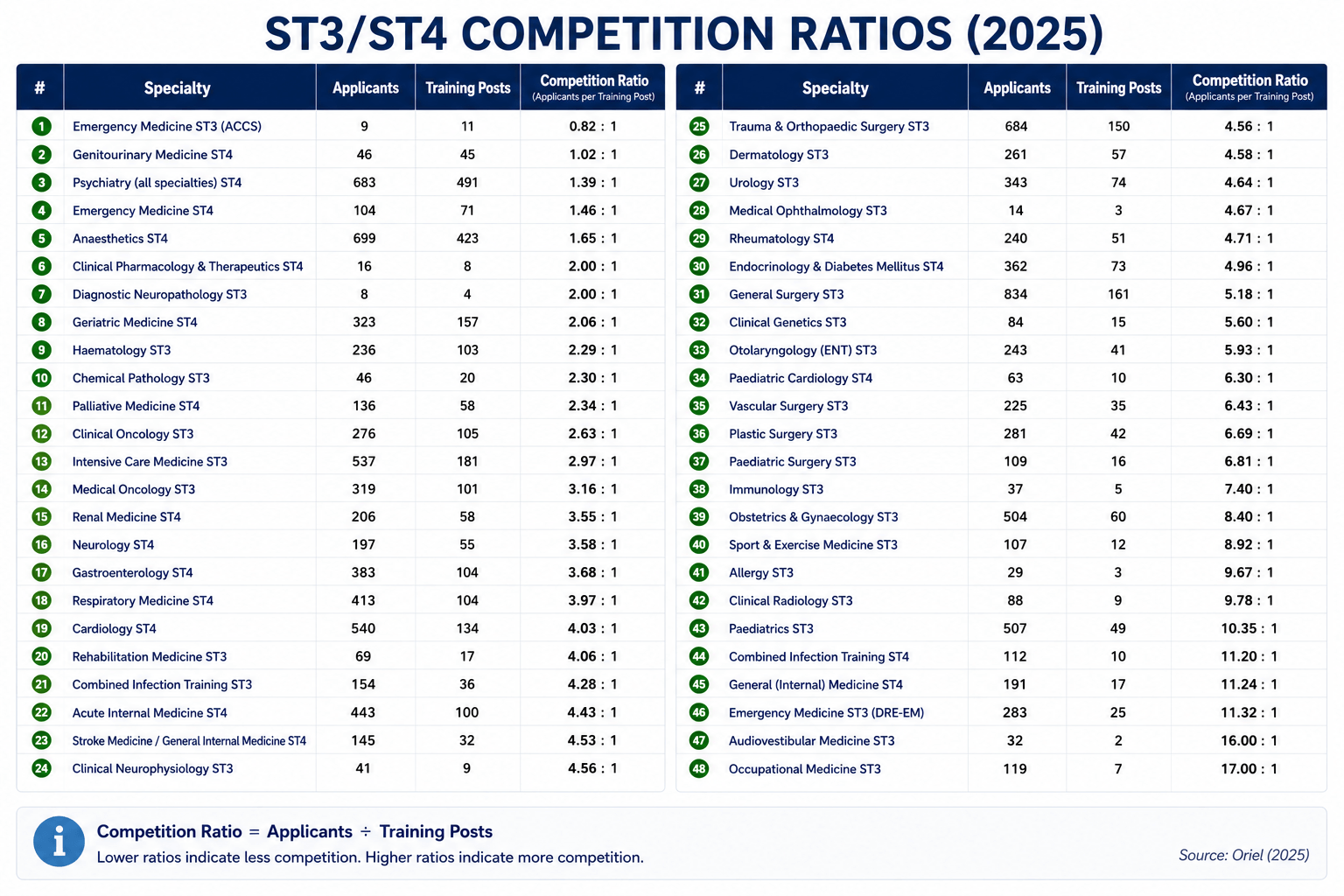
The graph below summarises the latest published NHS England Higher Specialty Training competition ratios. Unlike the CT1/ST1 figures shown earlier, these data relate to entry into higher specialty training programmes after completion of Core Training or an equivalent pathway.

Source: NHS England – Competition Ratios

Table showing the number of training posts, the number of applicants and the competition ratio for ST3 and ST4 posts in all specialities in the UK in 2025

Which higher specialties are most competitive

The 2025 Higher Specialty Training data demonstrate that competition varies considerably between specialties. While some programmes attract only one or two applicants per post, others remain intensely competitive despite recruiting relatively small numbers of trainees.

Several specialties stand out.

  • Occupational Medicine recorded one of the highest competition ratios, with 119 applications for just 7 posts (17.0:1). Although the specialty recruits only small numbers nationally, it continues to attract considerable interest from doctors seeking a career that combines clinical medicine with public health, workplace health and medico-legal practice.
  • Audiovestibular Medicine recruited just 2 trainees from 32 applications (16.0:1). With very few national training places available each year, even modest increases in applicant numbers can produce exceptionally high competition ratios.
  • Combined Infection Training (ST4) attracted 112 applications for only 10 posts, giving a competition ratio of 11.2:1. This reflects the limited number of higher training opportunities available once doctors have completed the initial stages of physician training.
  • General Internal Medicine (ST4) recorded a surprisingly high competition ratio of 11.24:1. Although General Internal Medicine is often perceived as a broad training pathway, relatively few standalone higher training posts are available, contributing to increased competition at this stage of recruitment.
  • Clinical Radiology (ST3) continues to attract exceptional demand, with 88 applications competing for just 9 higher training posts (9.78:1). Radiology remains one of the UK's most sought-after specialties, reflecting advances in imaging technology, increasing consultant demand and an attractive work-life balance.

Small specialties can produce very high competition ratios

One important lesson from the ST3/ST4 data is that competition ratios are heavily influenced by the number of available posts. Many higher specialty programmes recruit fewer than ten trainees nationally each year. Consequently, relatively small fluctuations in applicant numbers can produce dramatic changes in the published competition ratio.

For this reason, exceptionally high ratios should not automatically be interpreted as evidence that a specialty is impossible to enter. Rather, they often reflect the combination of a highly committed applicant pool and a very limited number of training places.

Conversely, specialties with competition ratios closer to 2:1 or 3:1 should not be considered "easy". Applicants at ST3/ST4 level have typically spent several years developing their portfolios, completing postgraduate examinations, undertaking research and gaining leadership experience. The overall standard of applicants is therefore considerably higher than at CT1/ST1 entry, meaning even specialties with relatively modest competition ratios remain highly selective.


Why lower competition ratios can be misleading

It is tempting to assume that a specialty with a competition ratio close to 1:1 must be easy to enter. In reality, this is not necessarily true. Lower competition may reflect:

  • Workforce shortages
  • Expansion of training numbers
  • Lower applicant numbers
  • Geographical variation
  • Service demand

The standard required to be appointable remains high. A poorly prepared applicant is unlikely to obtain a post regardless of the published ratio.

The real difference between CT1 and ST3 recruitment

Perhaps the biggest difference is not the ratio itself but how applicants are distinguished. At CT1/ST1 level, candidates often differ considerably in experience. By ST3/ST4, however, almost everyone has a strong CV. Portfolio scores become tightly clustered. Consequently, interviews become proportionally more important.

The successful candidate is often not the one with the longest CV, but the one who can demonstrate:

  • Clear clinical judgement
  • Structured decision-making
  • Leadership
  • Insight
  • Professionalism
  • Excellent communication under pressure

These are precisely the attributes that consultant interview panels value later in a doctor's career.


The most important message

Looking at the tables in this article, it would be easy to conclude that some specialties are simply "too competitive". That would be the wrong conclusion.

Competition ratios describe the applicant pool. They do not describe your potential. A doctor with an excellent portfolio and well-rehearsed interview technique is not competing against every applicant. They are competing against the relatively small proportion of candidates who have prepared to the same standard.

That distinction is the difference between seeing competition ratios as a barrier, and seeing them as something that can be overcome.

Why competition ratios don't predict your chances of success

It is easy to look at a competition ratio of 8:1 or 10:1 and conclude that your chances of success are only 10–12%. Fortunately, recruitment simply doesn't work like that. Competition ratios tell us how many eligible applications were submitted for each available post. They do not tell us how prepared those applicants were, how competitive their portfolios were, or how well they performed at interview. More importantly, they do not tell us where you sit within the applicant pool.


Recruitment is a ranking exercise - not a lottery

Imagine 300 doctors apply for 100 training posts. A competition ratio of 3:1 sounds intimidating. However, the recruitment panel is not randomly selecting one-third of applicants. Instead, every candidate is ranked according to their overall score. Depending on the specialty, this may include:

  • Clear clinical judgement
  • Structured decision-making
  • Leadership
  • Insight
  • Professionalism
  • Excellent communication under pressure

The highest-scoring applicants receive offers first. That means your objective is not to "beat" every applicant. It is to score highly enough to finish above the appointment threshold.


Most applicants are not perfect

One of the biggest misconceptions among applicants is the belief that everyone else has an exceptional CV. They don't. Every recruitment round includes applicants who:

  • Misunderstand the scoring criteria
  • Fail to maximise self-assessment points
  • Submit incomplete evidence
  • Underestimate the interview
  • Perform poorly under pressure
  • Apply with minimal preparation

The strongest candidates prepare strategically over many months. The weakest candidates often begin preparing only a few weeks before interview. This creates a surprisingly wide spread of performance.


Small improvements produce large gains

Competition ratios often make applicants think they need to become dramatically better than everyone else. In reality, relatively small improvements can make an enormous difference. Imagine a specialty with a competition ratio of 6:1. If you move from being an average applicant to one who scores within the top 20–25%, your likelihood of receiving an offer increases dramatically. You do not need to become the best applicant nationally. You simply need to perform better than the appointment threshold. This is why experienced interview coaches often focus on improving relatively small aspects of performance rather than attempting to reinvent candidates completely.

  • Clearer structure.
  • More confident communication.
  • Better prioritisation.
  • More insightful reflection.

Collectively, these relatively modest improvements can transform an application's competitiveness.

How to beat the competition ratios

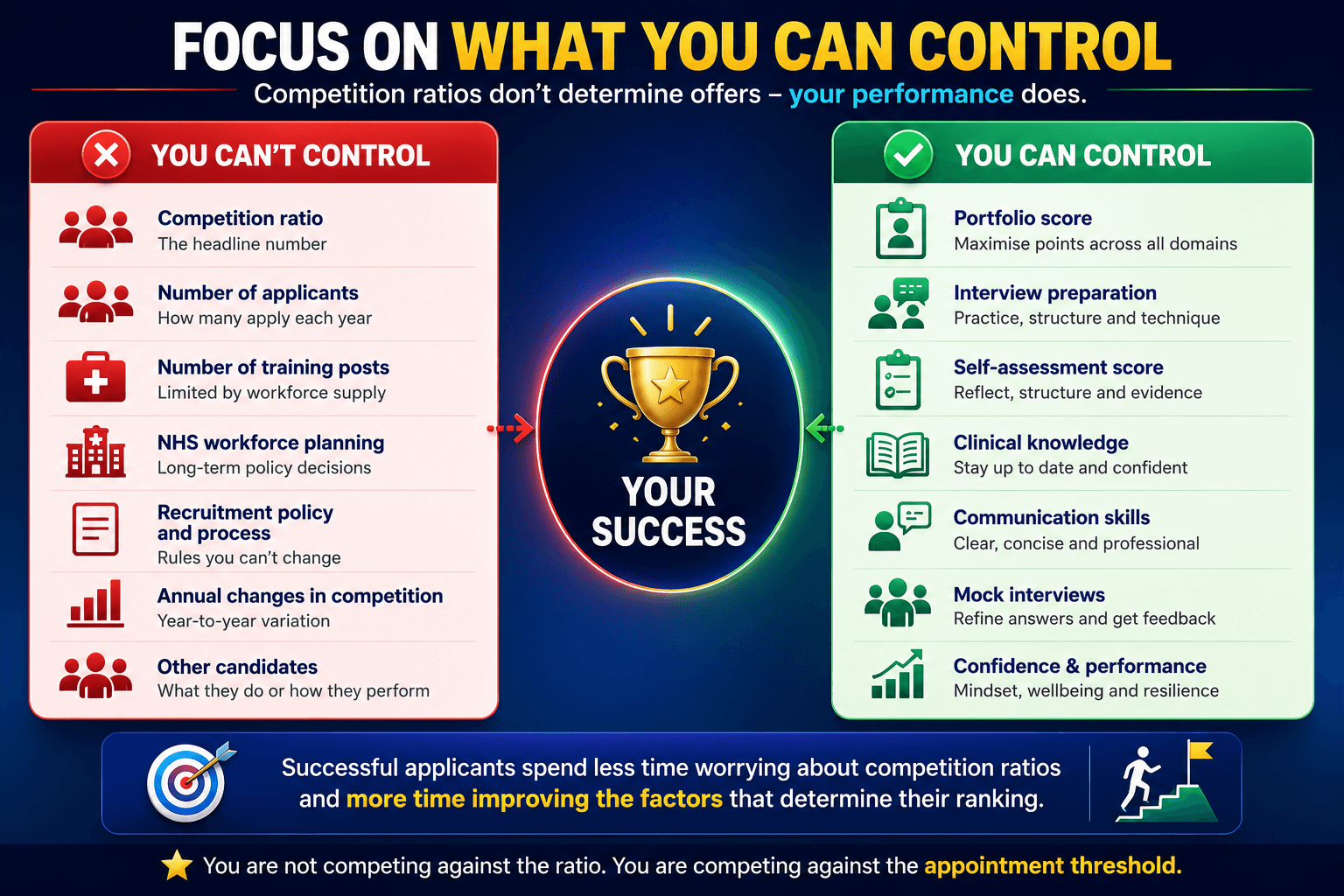
The encouraging news is that almost every aspect of your application can be improved. Unlike the published competition ratios, these are variables entirely under your control.


1 - Maximise your portfolio score

Portfolio points are among the easiest marks to gain because they can be planned months, or even years, in advance. Most specialties award marks for achievements such as:

Applicants who understand the scoring matrix early frequently gain a substantial advantage before interviews even begin.


2 - Understand the scoring matrix

Every recruitment programme publishes detailed self-assessment guidance. The highest-scoring applicants rarely collect achievements by accident. Instead, they work backwards from the scoring system. Rather than asking: "What have I done?", they ask: "What evidence do I need to achieve full marks?". This small change in mindset often separates average applicants from exceptional ones.


3 - Practise interviews under realistic conditions

Reading model answers is useful. Practising under pressure is considerably more valuable. Interview performance depends upon much more than clinical knowledge.

Successful candidates demonstrate:

  • Logical structure
  • Clear prioritisation
  • Concise communication
  • Confidence
  • Professionalism
  • Situational awareness

These skills improve through repeated practice rather than reading alone.


4 - Seek constructive feedback

One practice interview is rarely enough. High-performing candidates actively seek feedback from experienced interviewers who understand the marking criteria. Objective feedback frequently identifies weaknesses that applicants never notice themselves. Often, only a few relatively minor adjustments are required to improve interview scores significantly.


5 - Start earlier than everyone else

Perhaps the greatest competitive advantage is time. Building an excellent portfolio cannot be achieved during the month before applications open. Leadership roles, teaching experience, Quality Improvement Projects and publications all take time to develop. Applicants who begin preparing early place themselves in a much stronger position when recruitment opens.

Diagram showing how candidates to CT and ST posts in the UK across all specialties can focus their preparation for CT and ST interviews on the parameters they can control.


Frequently-asked questions

A specialty training competition ratio compares the number of eligible applications for a training programme with the number of posts available. It is calculated by dividing eligible applications by available posts. For example, 2,000 eligible applications for 500 posts would produce a competition ratio of 4:1. However, a competition ratio should be interpreted as a measure of demand rather than an individual applicant's probability of success. It does not take account of the strength of individual applications, interview performance or the fact that doctors may apply to several specialties during the same recruitment round..

No. A 10:1 competition ratio means that ten eligible applications were received for every available post; it does not mean that every applicant has an equal 10% chance of success.

Specialty recruitment is a ranking process rather than a lottery. Applicants may be differentiated through self-assessment, portfolio scoring, the MSRA and interview performance, depending on the specialty. Some candidates also apply to several specialties, withdraw from recruitment or decline offers because they have accepted a post elsewhere.

Your individual chances therefore depend much more on where you rank within the applicant pool than on the headline competition ratio.

Published competition figures count applications rather than unique doctors. A doctor applying to Internal Medicine Training, General Practice and Psychiatry, for example, contributes one application to the competition figures for each of those three specialties.

In 2025, NHS England reported an average of 2.37 specialty applications per Round 1 applicant. This means the total number of applications substantially exceeded the number of individual doctors seeking training posts.

Competition ratios therefore tell us how much demand exists for a programme, but can exaggerate the number of individual doctors genuinely competing for each post.

The Medical Training (Prioritisation) Act 2026 introduced a major change to specialty recruitment by requiring priority applicants to be considered for training offers before non-priority applicants.

For 2026 recruitment, prioritisation was implemented at the offer stage.

Other recruitment changes included a maximum of five specialty applications during Round 1 recruitment, changes to GMC registration requirements and the creation of additional specialty training posts.

From 2027 recruitment, prioritisation will go further and will apply at both the shortlisting and offer stages.

These changes mean that historic competition ratios need to be interpreted carefully when considering the current recruitment landscape.

For 2026 recruitment, prioritisation was implemented at the offer stage rather than at shortlisting.

From 2027 recruitment, this changes. Prioritisation will apply at both the shortlisting and offer stages.

This means priority status may affect progression through shortlisting before interview as well as the subsequent allocation of training offers.

However, prioritisation does not guarantee an interview or training offer. Applicants must still meet the relevant eligibility and selection requirements for their specialty.

Non-priority applicants who are invited to interview should still attend. Interview ranking remains based on performance in the relevant specialty selection process.

The final additional priority criteria for 2027 have not yet been confirmed, so applicants should refer to the latest NHS England guidance when the regulations are published.

The 2025 figures are currently the latest complete NHS England dataset providing detailed specialty-by-specialty competition ratios.

They also represent the final complete specialty-level dataset from before the Medical Training (Prioritisation) Act changed the recruitment system.

For 2026 recruitment, prioritisation was implemented at the offer stage. From 2027, it will also apply at shortlisting.

The 2025 figures therefore remain useful for comparing historic demand between specialties, but they should not be treated as a direct prediction of the effective competition faced by an individual applicant under the new recruitment system.

The Medical Training (Prioritisation) Act provides priority to specified groups, including UK medical graduates and applicants who have completed, or are currently undertaking, relevant qualifying UK training programmes.

For 2026 recruitment, certain immigration statuses were also used as a practical proxy for significant NHS experience.

Those immigration-status criteria do not automatically apply to 2027 recruitment.

For 2027, an additional priority group can be defined through regulations, including by reference to significant NHS experience or immigration status.

At the time of our September 2026 update, the final criteria for this additional group have not yet been confirmed. NHS England has said that updated information is expected ahead of the 2027 application round.

Competition varies considerably from year to year and also depends on whether you are considering CT1/ST1 or higher specialty recruitment.

In the 2025 CT1/ST1 recruitment data, Ophthalmology and Core Psychiatry had competition ratios above 20 applications per post, while Clinical Radiology and Core Surgical Training also attracted substantially more applicants than available places.

At ST3/ST4 level, some smaller specialties can produce very high competition ratios because only a handful of posts are available nationally. A high ratio therefore does not necessarily mean that a specialty has an unusually large number of applicants; sometimes it simply reflects a very small number of available posts.

Internal Medicine Training had 8,841 applications for 1,678 posts in the 2025 recruitment round, giving an IMT competition ratio of approximately 5.27:1. However, IMT is also one of the largest specialty training programmes in the UK. Applicants should therefore avoid interpreting 5.27:1 as their personal chance of success. Final outcomes depend on the recruitment and ranking process, including performance at interview. Doctors preparing for recruitment can read more about IMT interview preparation and the current interview process in our dedicated IMT resources.

Core Surgical Training received 5,399 applications for 630 posts in 2025, producing a competition ratio of approximately 8.57:1. CST has traditionally been a competitive entry route, and applicants are differentiated not simply by the number of people applying but by their performance across the recruitment process. Developing relevant achievements early and preparing carefully for selection are therefore considerably more useful than focusing solely on the headline CST competition ratio.

Not necessarily in terms of the numerical competition ratio, but higher specialty recruitment can be more challenging for a different reason: the standard of the applicant pool.

By ST3 or ST4, candidates have usually spent several years developing specialty-specific experience, completing postgraduate examinations and building evidence in areas such as teaching, Quality Improvement, research and leadership. Applicants may therefore have much more similar portfolios than at CT1/ST1.

As a result, relatively small differences in interview performance can become particularly important when candidates are closely matched.

Yes. Competition for many UK specialty training programmes increased substantially during the first half of the 2020s as application numbers grew faster than the number of available training posts.

However, historic trends should now be interpreted cautiously. Changes introduced in 2026, particularly applicant prioritisation, limits on Round 1 applications and additional training posts, have significantly changed the recruitment environment.

For this reason, comparing a competition ratio from one year with another does not necessarily provide a like-for-like measure of how difficult it is for an individual doctor to obtain a training post.

Competition ratios can be useful when understanding recruitment trends, but they should not be the main factor determining your career choice.

A specialty with a lower competition ratio is not necessarily easier to enter, particularly if applicants are highly experienced or only a small number of posts are available. Competition also changes between years and geographical regions.

Your interests, abilities, preferred type of clinical work, lifestyle considerations and long-term career plans are much more important. Once you have chosen a specialty that genuinely suits you, concentrate on becoming as competitive an applicant as possible.

Official specialty recruitment competition ratios are published by NHS England using recruitment data from national specialty training programmes.

The figures generally compare the number of eligible applications received with the number of posts available during a particular recruitment round. Because they count applications rather than unique doctors, they should not be interpreted as the percentage probability of an individual applicant obtaining a post.

This guide uses official NHS England recruitment data and is updated as new specialty-level figures become available.

Official specialty recruitment competition ratios are published by NHS England using recruitment data from national specialty training programmes.

Yes. A national competition ratio can conceal substantial variation in the popularity of individual regions and training programmes.

Some locations attract particularly high numbers of applicants because of geography, teaching hospitals, academic opportunities, family circumstances or lifestyle preferences. Applicants who are flexible about where they train may therefore have a wider range of options than the national headline ratio suggests.

However, recruitment and preferencing arrangements vary between specialties, so applicants should always check the current recruitment guidance for their chosen programme.

This guide uses official NHS England recruitment data and is updated as new specialty-level figures become available.

Although you cannot control the number of applicants or training posts, you can significantly improve your chances by focusing on the factors that determine your ranking. Build your portfolio early, maximise self-assessment points, gain teaching, leadership and quality improvement experience, understand the scoring criteria and practise interviews under realistic conditions with experienced interviewers. Even relatively small improvements in interview performance and portfolio score can move an applicant above the appointment threshold in highly competitive specialties.

Sources and further reading

And remember

Competition ratios undoubtedly attract attention every year, and it is understandable that they can appear intimidating. However, they represent only one small part of the recruitment process. The applicants who consistently secure their preferred specialty are rarely those who spend the most time worrying about the published figures. They are the ones who understand the recruitment process, maximise every available portfolio point, prepare systematically for interview and continuously refine their performance.

Remember, you are not competing against every applicant. You are competing against the appointment threshold. The closer you move towards the top of the scoring system, the less important the overall competition ratio becomes. Whether you are applying for your first CT1/ST1 post or progressing to Higher Specialty Training at ST3/ST4 level, careful preparation remains the single greatest predictor of success.

Ready to maximise your chances?

Competition ratios tell you how many applications are being made for each training post. They can't tell you where you will rank. That is the part you can influence.

Once you reach the interview stage, thorough preparation can make a significant difference. Understanding the interview format, anticipating the areas you may be assessed on and practising how you structure and communicate your answers can all help you convert a strong application into a competitive interview performance.

If you are applying for Internal Medicine Training, our IMT Interview Course provides focused preparation for the IMT interview, with structured teaching, practical interview practice and personalised feedback.

For applicants preparing for CT, ST and higher specialty training interviews, our CT/ST Interview Course provides practical preparation for the key areas commonly assessed at specialty interviews.

If you prefer to prepare independently, our CT/ST Medical Interview Book and Guide provides comprehensive guidance on interview technique, common questions, marking approaches and how to develop stronger, more effective answers.

Ultimately, you cannot control how many other doctors apply for a specialty. You can control the quality of your application, the preparation you put in and how effectively you perform when you reach interview.

About the author

Olivier Picard is the founder and Managing Director of ISC Medical and Course Director for all ISC Medical courses. He has been training and coaching doctors for more than 22 years and has worked with clinicians at every stage of their careers, from doctors entering specialty training through to senior clinicians applying for NHS consultant and leadership posts.

He has designed and developed ISC Medical's programmes in medical teaching, communication, leadership, management and interview skills, and has trained many of the faculty who now deliver these courses. Over that time, he has taught thousands of doctors and has continued to refine his own approach through experience, learner feedback and working alongside other experienced trainers.

Olivier is also the author of several books for doctors, including Medical Interviews: A Comprehensive Guide to CT, ST & Registrar Interview Skills, which has been published in multiple editions since 2008. His books draw on the same practical approach that underpins ISC Medical's courses, translating professional and educational principles into techniques that doctors can apply in interviews, clinical practice and their wider careers.

His approach to education is strongly practical. Rather than treating educational theory as an end in itself, he is particularly interested in how it can help doctors understand why some approaches to teaching work better than others, recognise habits that may have become established over time and adapt their teaching to different learners and clinical situations.

As Course Director, Olivier remains closely involved in the design and continuing development of ISC Medical's courses, as well as the development of its faculty. His focus is on ensuring that teaching remains engaging, evidence-informed and, above all, useful in the real situations doctors encounter when teaching, communicating, leading and supporting colleagues in clinical practice.


Loading...