

2025 Competition Ratios for CT1/ST1 Entry
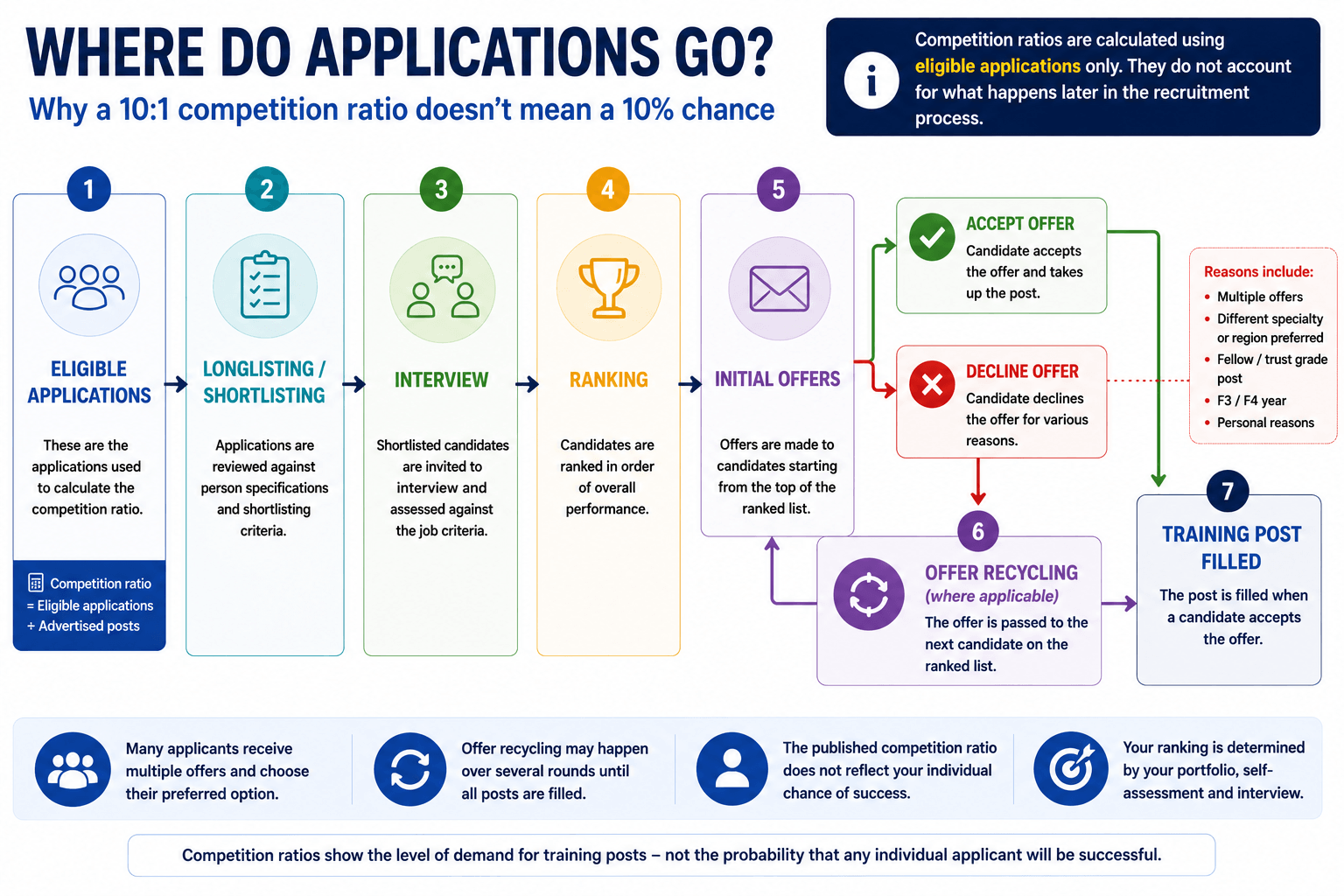
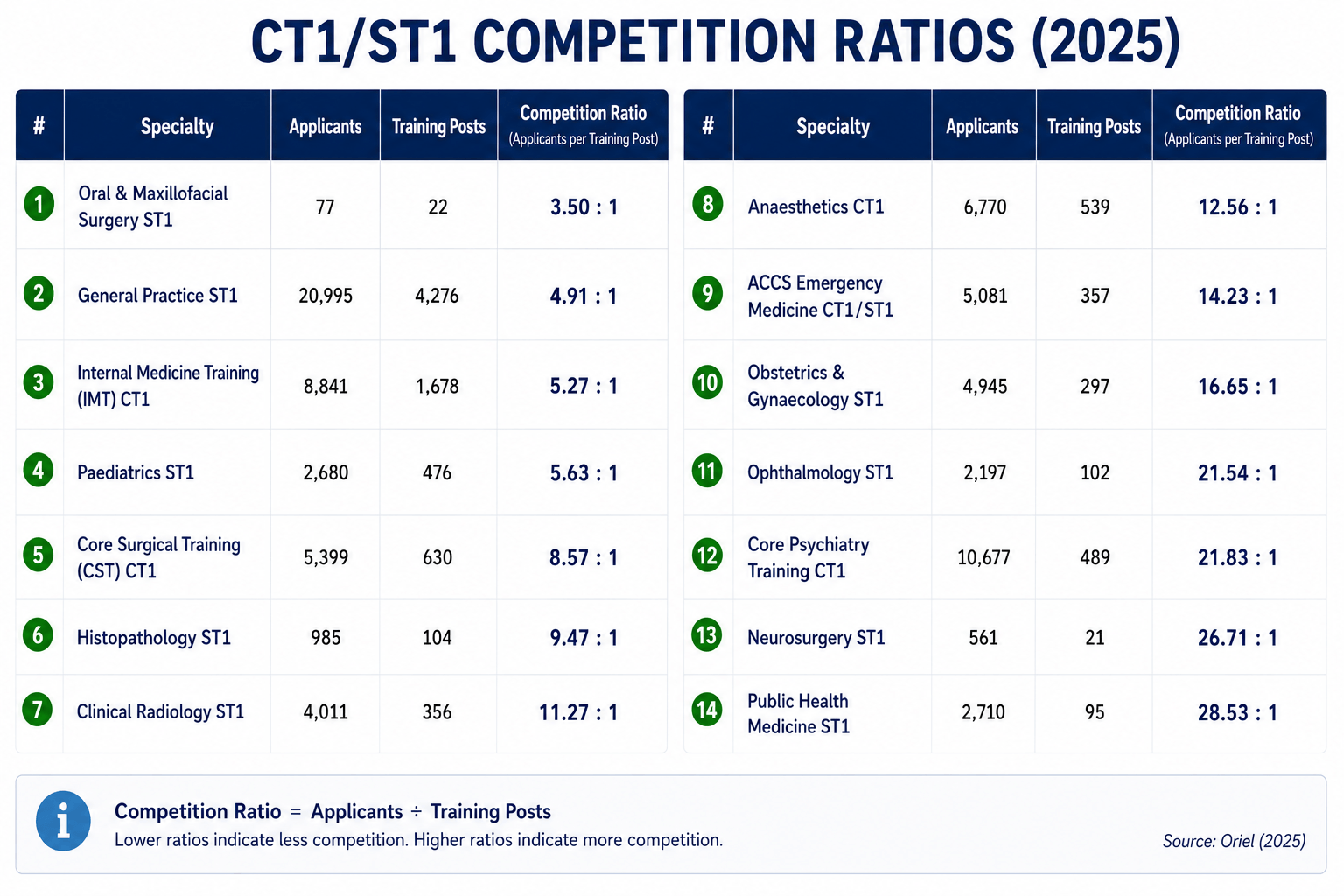
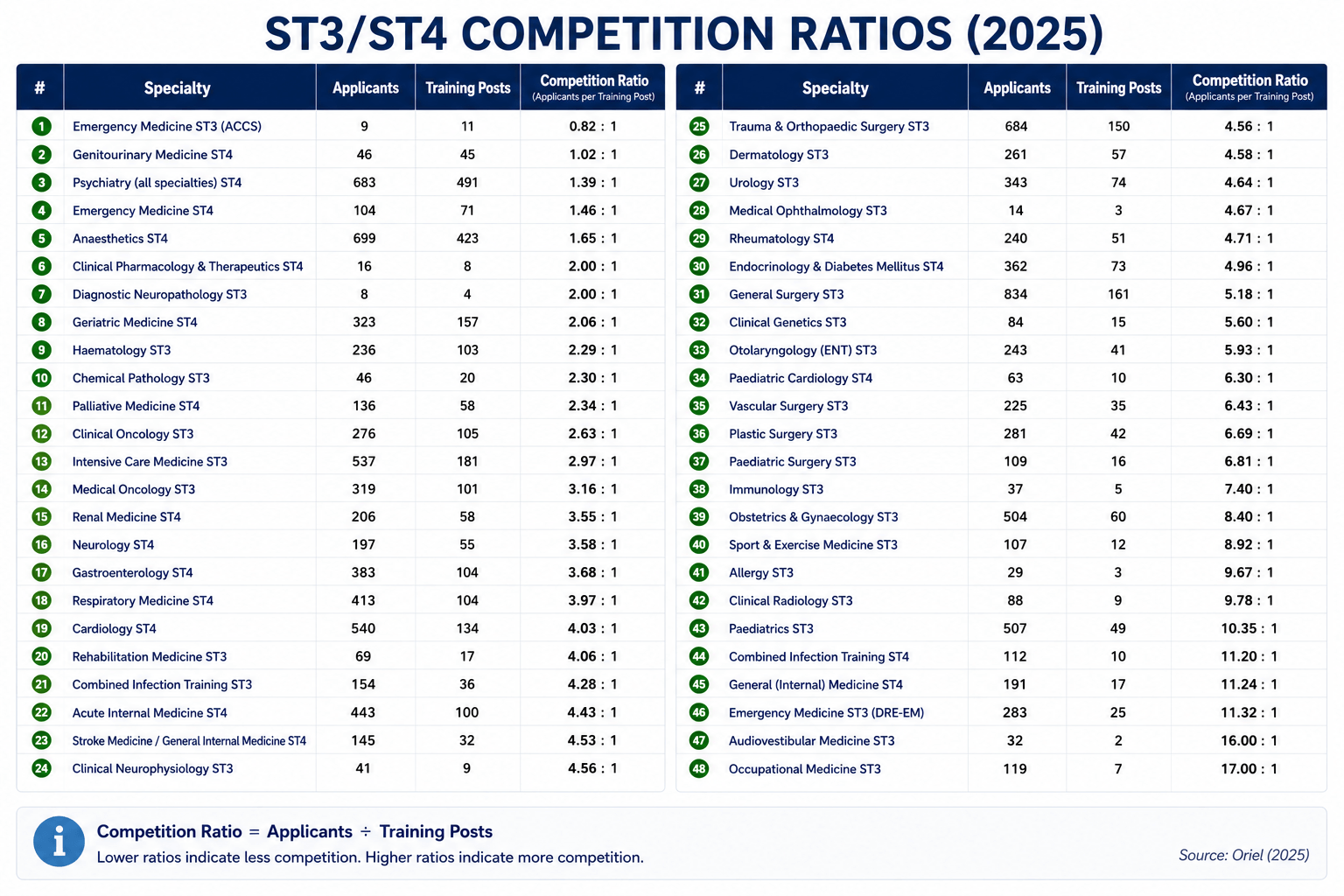
The table below summarises the latest published NHS England Round 1 competition ratios for the principal entry specialties. Remember that these figures represent applications per available training post rather than an individual's chance of success.
Several clear patterns emerge from the 2025 data
General Practice and Psychiatry Continue to Offer Major Training
General Practice remains the largest specialty recruitment programme in the UK, offering more than 4,000 training posts each year. Although its competition ratio of 4.91:1 is lower than many of the most competitive hospital specialties, it still demonstrates that entry into General Practice is far from guaranteed.
By contrast, Core Psychiatry Training attracted 10,677 applications for 489 posts, giving a competition ratio of 21.83:1. This reflects a substantial increase in applications in recent years and demonstrates that Psychiatry can no longer be regarded as a relatively low-competition specialty.
Applicants should therefore avoid assuming that expanding specialties automatically provide an easier route into specialty training. Regardless of specialty, successful candidates still need to demonstrate excellent clinical knowledge, professionalism and communication skills throughout the recruitment process.
Internal Medicine Training Remains One of the Largest Entry Routes
With 8,841 applications for 1,678 posts, Internal Medicine Training (IMT) recorded a competition ratio of 5.27:1 in 2025.
As the gateway into numerous physician specialties (including Cardiology, Gastroenterology, Respiratory Medicine, Neurology, Endocrinology and Geriatric Medicine), IMT continues to attract large numbers of applicants each year.
Competition remains strong, but applicants should remember that IMT also offers one of the largest numbers of available training posts nationally. Consequently, maximising self-assessment points and performing well at interview can have a significant impact on an applicant's final ranking.
Clinical Radiology Continues to Attract Exceptional Demand
Clinical Radiology remains one of the UK's most competitive entry specialties, attracting 4,011 applications for just 356 training posts, giving a competition ratio of 11.27:1. Several factors contribute to its popularity, including excellent career satisfaction, rapid technological advances, including artificial intelligence, opportunities for subspecialisation, favourable work-life balance and strong consultant demand across the NHS. Although highly competitive, applicants with strong portfolios and excellent interview performance continue to secure training posts every year.
Ophthalmology Remains Exceptionally Competitive
Ophthalmology continues to be one of the most competitive specialties in the UK, with 2,197 applications competing for only 102 training posts, producing a competition ratio of 21.54:1. Its popularity is driven by: high levels of job satisfaction, microsurgical practice, excellent work-life balance, opportunities for private practice and highly specialised clinical work. Because relatively few posts are available nationally, applicants typically require exceptionally strong portfolios alongside excellent interview performance.
Core Surgical Training Remains Highly Competitive
Core Surgical Training attracted 5,399 applications for 630 posts, resulting in a competition ratio of 8.57:1. Unlike some specialties, success in CST depends heavily upon achievements accumulated before applications open. Audit and Quality Improvement projects, teaching, leadership, research and clear evidence of commitment to surgery all contribute valuable portfolio points. Applicants who begin preparing early frequently gain a significant advantage over those who start only a few months before recruitment
Competition Ratios Are Only Part of the Story
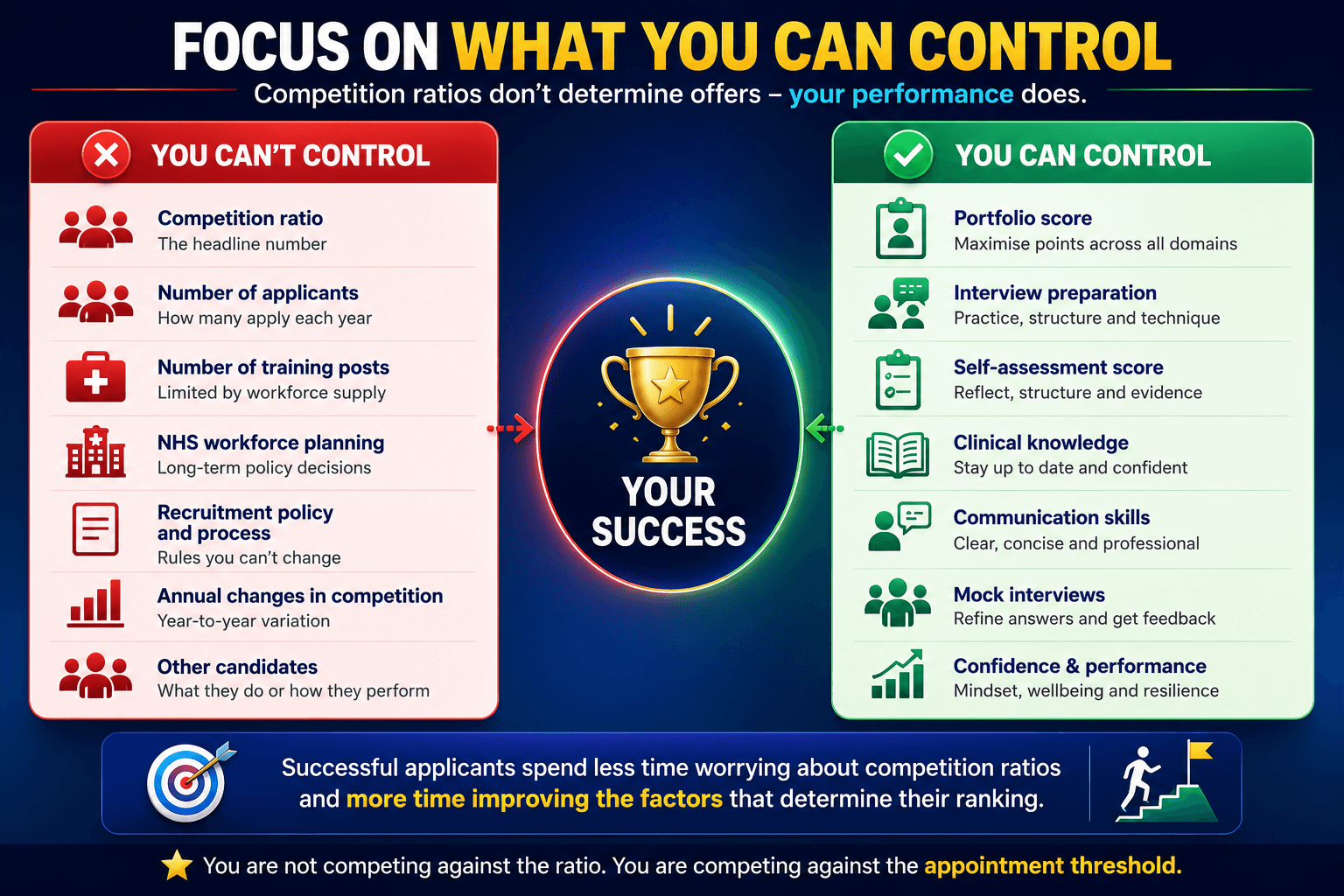
The official 2025 figures demonstrate considerable variation between specialties, with competition ratios ranging from around 3.5:1 in Oral and Maxillofacial Surgery to more than 21:1 in Ophthalmology and Core Psychiatry. However, these headline figures should not be interpreted as an individual's probability of success. Recruitment panels rank applicants according to portfolio achievement, self-assessment and interview performance. A well-prepared candidate applying to a specialty with a competition ratio of 10:1 may have a considerably higher chance of success than an average applicant applying to a specialty with a much lower published ratio. The most successful applicants therefore spend less time worrying about the published competition ratios and more time maximising every available mark.